The Curious World of Seaweed
An exhibition of these prints has been at various regional museums, culminating in an exhibit at the Belvedere Tiburon Library from July 15, 2026 through September 15, 2026. The accompanying website includes the captions for each print and a link to a video of Dr. Patrick Martone, professor of phycology, explaining each particular seaweed or kelp in its intertidal home. I am thrilled by this robust combination of art & science, bringing you all into The Curious World of Seaweed. I hope you might explore the website and return here if you cannot attend the exhibit in person and are interested in purchasing a fine art print from this portfolio. The archival collection of prints is HERE. The exhibit is available through Exhibit Envoy.

Costaria costata or five-ribbed kelp.
27” x 62” fine art print on Hahnemuhle rag paper, edition of 10.

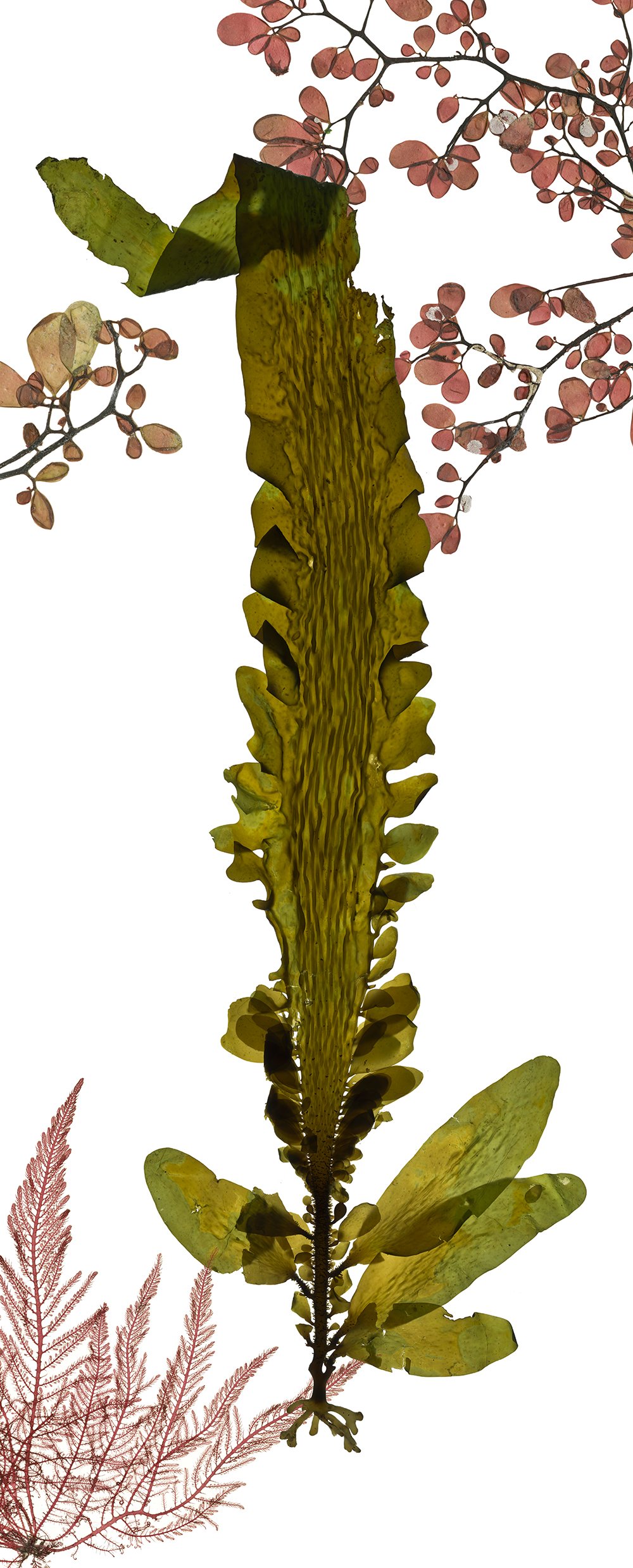
Nereocystis leutkeana, or bull kelp.
25” x 62” fine art print on Hahnemuhle rag paper. Edition of 10.
Nereocystis is the dominant canopy-creating kelp of the north Pacific. It is an annual, growing almost a foot a day during the longer days of springtime, a feat of photosynthetic magnificence. It then creates sori, dark brown spore patches on its blades that migrate towards the end and finally fall away as a packet of millions of spores to the ocean bottom. The bull kelp has a cryptic alternate, sexual life stage where the spores develop into microscopic female and male organisms that generate egg and sperm that come together, under the ocean amidst the rough and cold waters. The fertilized egg then develops into the tiny bull kelp that will grow down into a holdfast adhered to a rocky substrate, and up as the single straight stipe with a single gas-filled bladder stretching towards the surface so the blades can collect as much sunlight and ocean nutrients as possible.
25” x 62” fine art print on Hahnemuhle rag paper. Edition of 10.
Egregia menzeisii, or feather boa kelp. Feather boa kelp is one of the most common kelps on the eastern edge of the Pacific, growing in the low intertidal to subtidal zones from Mexico to Alaska. It is a perennial, its holdfast remaining throughout the winters while the blades get beaten back by storm surges to emerge again from the same holdfast in spring. This is a juvenile Egregia, with a still small holdfast. I have checked on certain Egregia holdfasts that have persisted for five years or so creating substantial mounds of their haptera (the root-like structures that make up the holdfast).

25” x 62” fine art print on Hahnemuhle rag paper. Edition of 10.
Laminaria setchellii or kombu. Laminaria setchellii is a common kelp in the near subtidal, its rich brown blades emerging from the waters just beyond the low tide mark. This species of laminaria is named after the grandfather of California seaweed, William Albert Setchell, who was head of the botany department at UC Berkeley from 1895-1915 and championed the study of the seaweeds and sea grasses, having many collectors up and down the coast sending him specimens. Laminaria setchellii used to be named Laminaria digitata, for its hand-like presentation, but the Pacific species got renamed in 1957. It is harvested, dried and marketed as California kombu, a wonderful addition to soups and stock.

27” x 62” fine art print on Hahnemuhle rag paper. Edition of 10.
Saccharina latissima or sugar kelp. This sugar kelp specimen was collected from the waters of Penobscot Bay in the Gulf of Maine. It actually has a juvenile kelp overlaid along its middle. While most kelps are native to a specific edge of a specific ocean, sugar kelp is found throughout the world’s oceans. It grows fast and abundantly creating significant biomass from the simple availability of sunlight and ocean nutrients, so it is a favorite species for the exploding enterprise of kelp farming, from Alaska to Maine. The microscopic sexual phase of its life cycle is controlled in a lab so that spores are produced to settle on a twine that is wound around a larger rope that, once strung between buoys in the ocean will host the holdfast while the blades grow rapidly out from the rope, through wintertime.
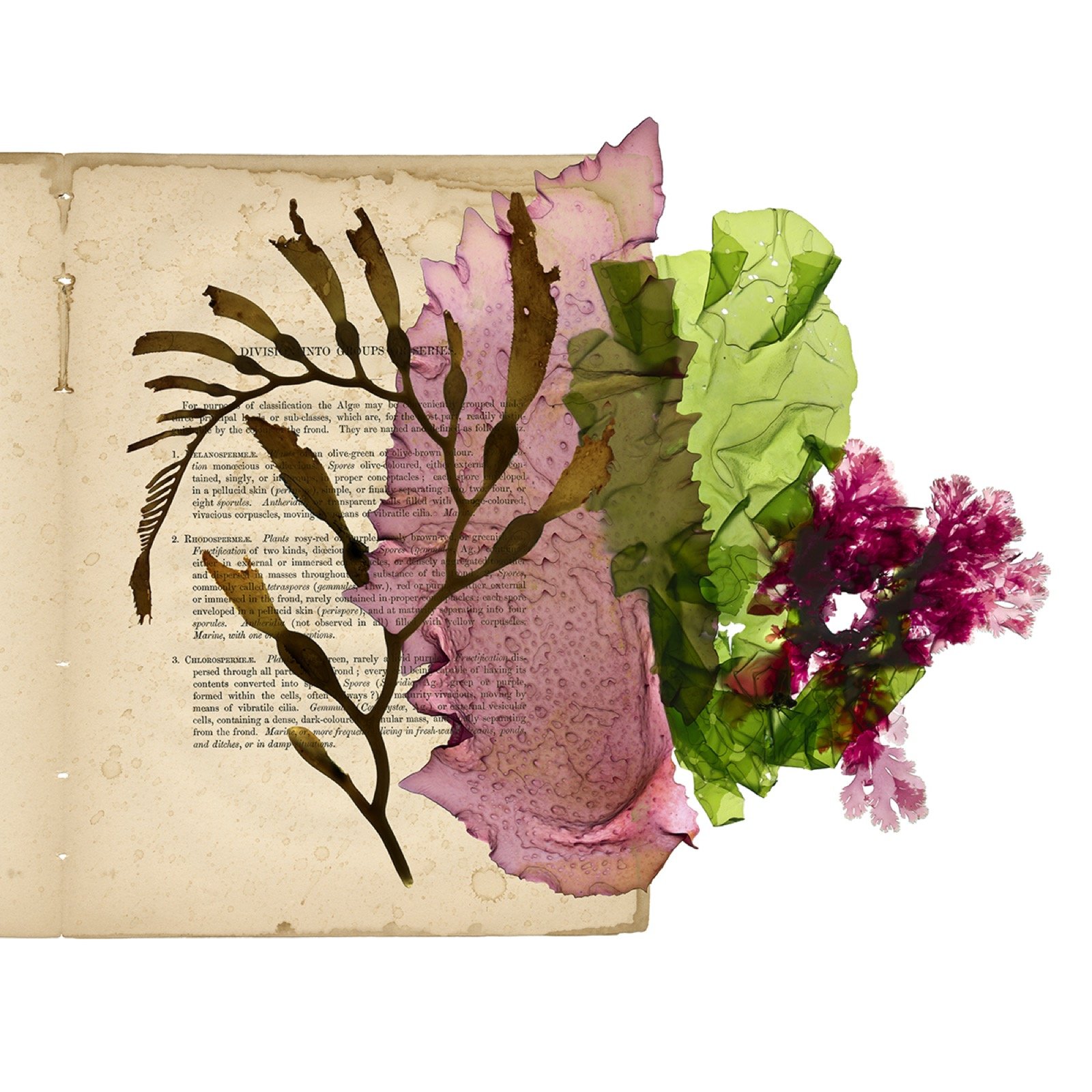
32” x 32” fine art print on Hahnemuhle rag paper. Edition of 10.
Three evolutionary lineages of seaweed: The greens, the reds, and the browns. The basic taxonomic grouping of the seaweeds by colour was established by William Henry Harvey and these scans of Ulva (greens), Chondracanthus and Callophyllus (reds) and Macrocystis pyrifera (browns) sit atop the page from Harvey’s Nereis Boreali-Americana (1852) where he describes these groups. “For purposes of classification, the Algae may be conveniently grouped under three principal heads or sub-classes, which are, for the most part, readily distinguishable by the colour of their frond.” His terms were Melanospermeae (the browns), Rhodospermeae (the reds), and Chlorospermeae (the greens). Although the terminology has changed slightly, the same colour groups are used today.


16” x 21” fine art print on Hahnemuhle rag paper with 1” white border. Edition of 10. 100% of proceeds go directly to University & Jepson Herbarium at UC Berkeley.
Pyropia with Pyropia (formerly Porphyra). Two specimens of Pyropia, the Pacific version of Porphyra or nori are combined, one collected by Kathy Ann Miller, Bodega Head, California, 2008, the other (Porphyra growing on Nereocystis) collected in Kodiak, Alaska in 1899, both from the collections at the University Herbarium, University of California, Berkeley, nos. 95674 & 1965038.

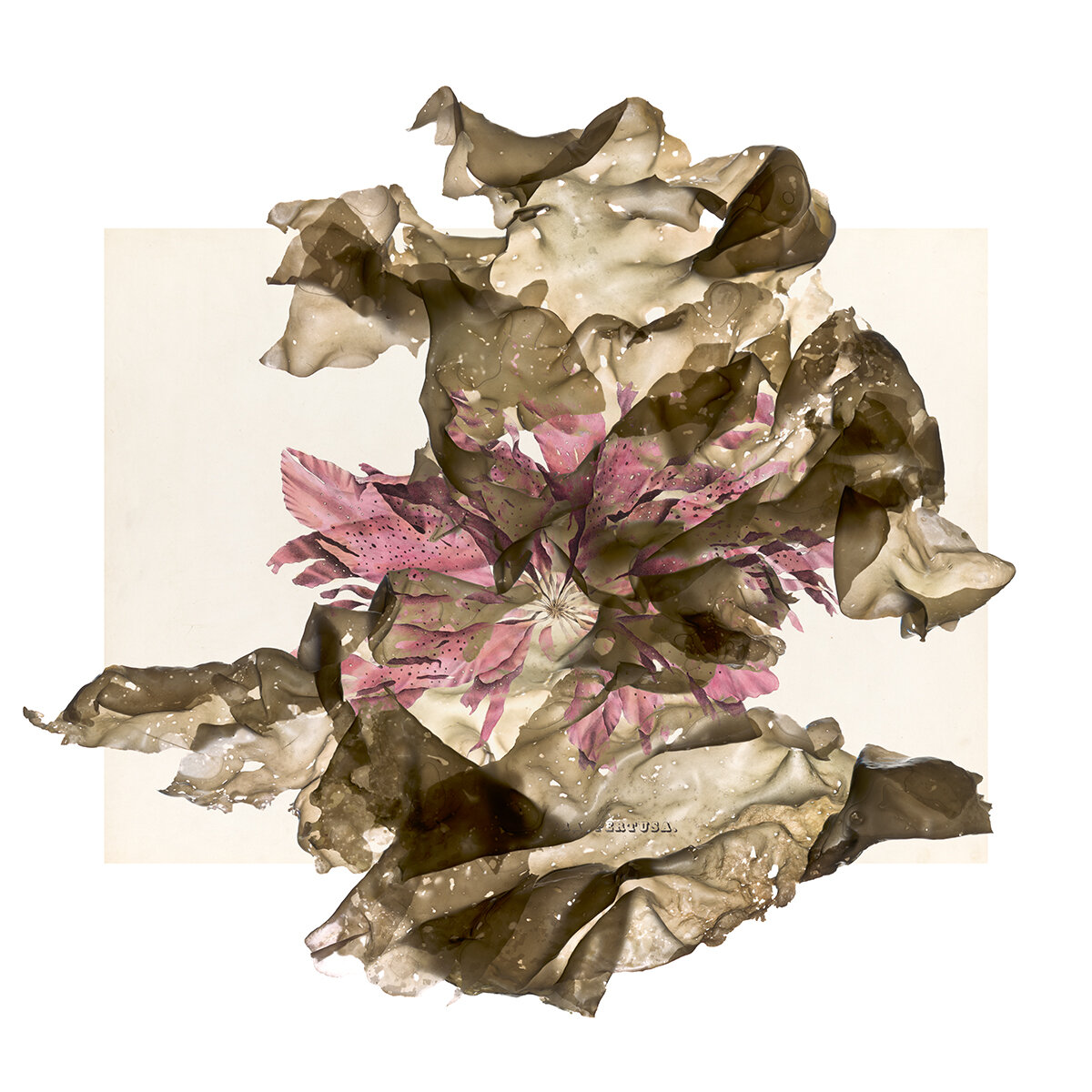
20” x 20” or 32” x 32” fine art print on Hahnemuhle rag paper. Edition of 15 or 10.
Pyropia with Porphyra pertusa. Scan incorporating illustration by Alexander Postels from Illustrationes algarum (1840).


20” x 20” or 32” x 32” fine art print on Hahnemuhle rag paper with 1.5” white border. Edition of 15 or 10.
A circle of red coralline algae. These are various articulated coralline algae collected from Botanical Beach at Port Renfrew on the west coast of Vancouver Island, where Josephine Tilden established the first marine lab on the west coast in 1900, named The Minnesota Seaside Station. Some of the species seen here are Corallina, Bossiella, Calliarthron, and others. The coralline algae are in the red group, thus their pink colour and they calcify in their cell walls as a strategy against herbivory.


12” x 26” or 24” x 53” fine art print on Hahnemuhle rag paper with 1.5” white border. Edition of 15 or 10.
Encrusting red coralline algae. Bottle from the collection of Kathy Ann Miller, Curator of Algae at the University Herbarium, UC Berkeley. Encrusting coralline algae spreads on rock surfaces and creates a crustose underlayer to a rocky reef, often giving signals for settlement of invertebrates.
20” x 20” or 32” x 32” fine art print on Hahnemuhle rag paper. Edition of 15 or 10.
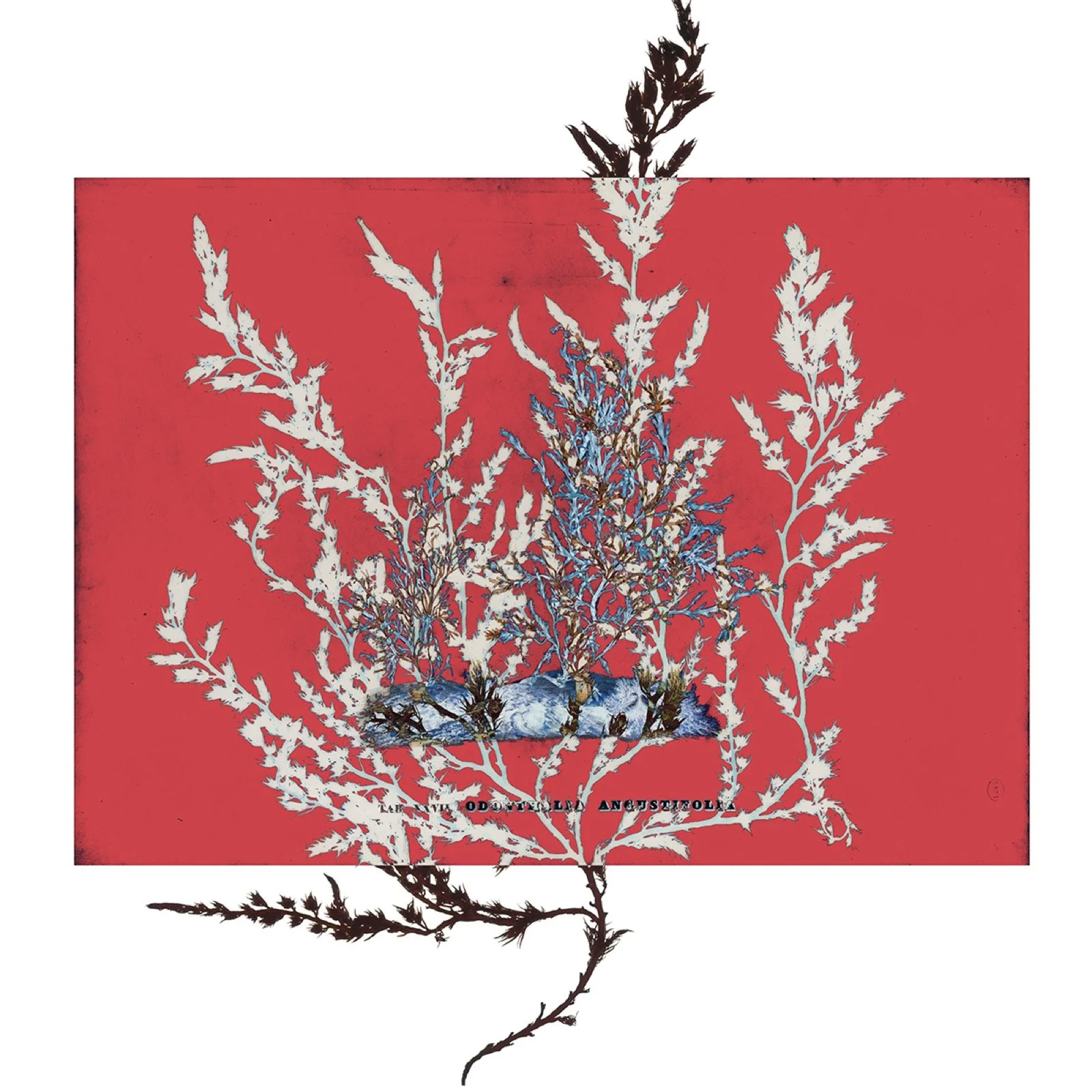
Odonthalia floccosa on a Postels lithograph from Illusatrationes algarum (1840).


8” x 8.5” or 26” x 30” fine art print on Hahnemuhle rag paper with 1.5” white border. Edition of 15 or 10.
Zostera marina on a drawing of Phyllospadix torreyi from the textbook, Marine Botany, by E. Yale Dawson. E. Yale Dawson was a prolific phycologist, publishing many papers and writing extensively on the seaweeds of the Pacific Coast, including this textbook on marine botany. He also did many of his own illustrations and was intent on also writing for the casual visitor to the seaside, introducing the seaweeds to the general public. He died tragically of a diving accident in 1966.

13” x 16” fine art print on Hahnemuhle rag paper. Edition of 15.
Microcladia coulteri and Osmundea with Gmelin, Plate xx: Contemporary scans incorporating an illustration by Samuel Gottleib Gmelin from Historia Fucorum (1768). Gmelin’s volume was the first flora describing the seaweeds, or marine algae as a separate grouping from vascular plants giving rise to their study as a discrete corner of botany. I have created a series of images where my contemporary scans work in dialogue through time with historic taxonomic imagery.


34” x 26” fine art print on Hahnemuhle rag paper. Edition of 10.
Pyropia perforata, or nori. Note the fertile edges. Pyropia is only two cells thick, every cell on the translucent blades is able to photosynthesize and every cell can gather nutrients directly from the ocean waters around it. Nori dries out to a crisp at low tide when the sun and wind are desiccating forces, but rehydrates every six hours as the tide comes in.
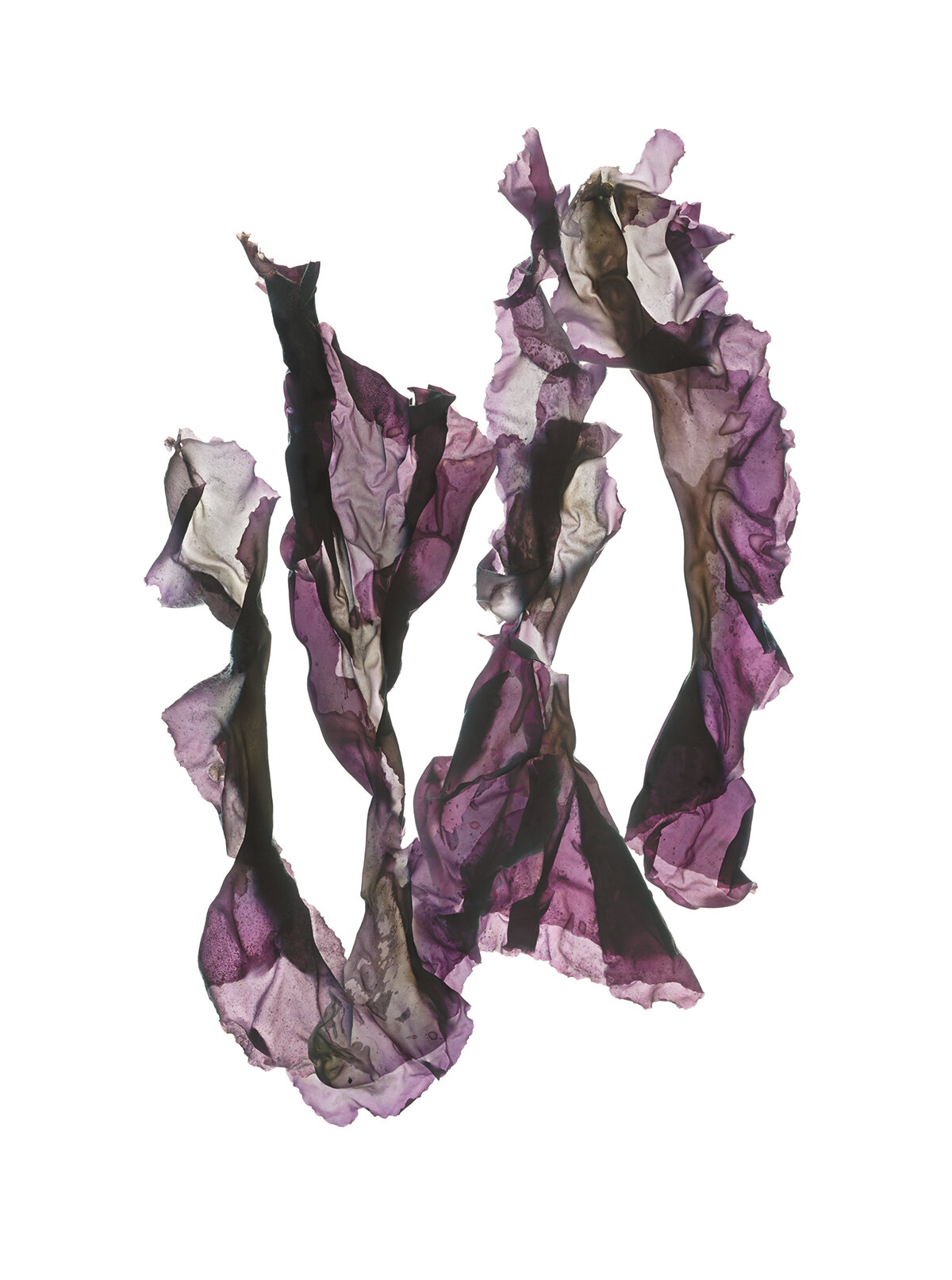
16” x 21” fine art print on Hahnemuhle rag paper. Edition of 15.
Scraps of Pyropia spp. Pyropia can be dusky green, almost black or vibrantly purple, like these scraps of dancing nori. No matter what outward colour, they are in the red category of seaweed, and their complex life cycle was teased out by British phycologist, Kathleen Drew-Baker. Drew-Baker had noticed with intrigue the fall bloom of Porphyra, locally known as laver. She focused her attention on this alga and what she initially supposed was a different species, the filamentous algae Conchocelis that grew as splotches of red or purple in old oyster shells. Her great discovery was that these two were not different species but different life stages of the same one. The familiar Porphyra in the local (UK) laverbread and what the Japanese press into sheets of nori were but one stage of an alternating generational cycle. Drew-Baker wrote up her observations and a simple description of the two stages of Porphyra’s life history.
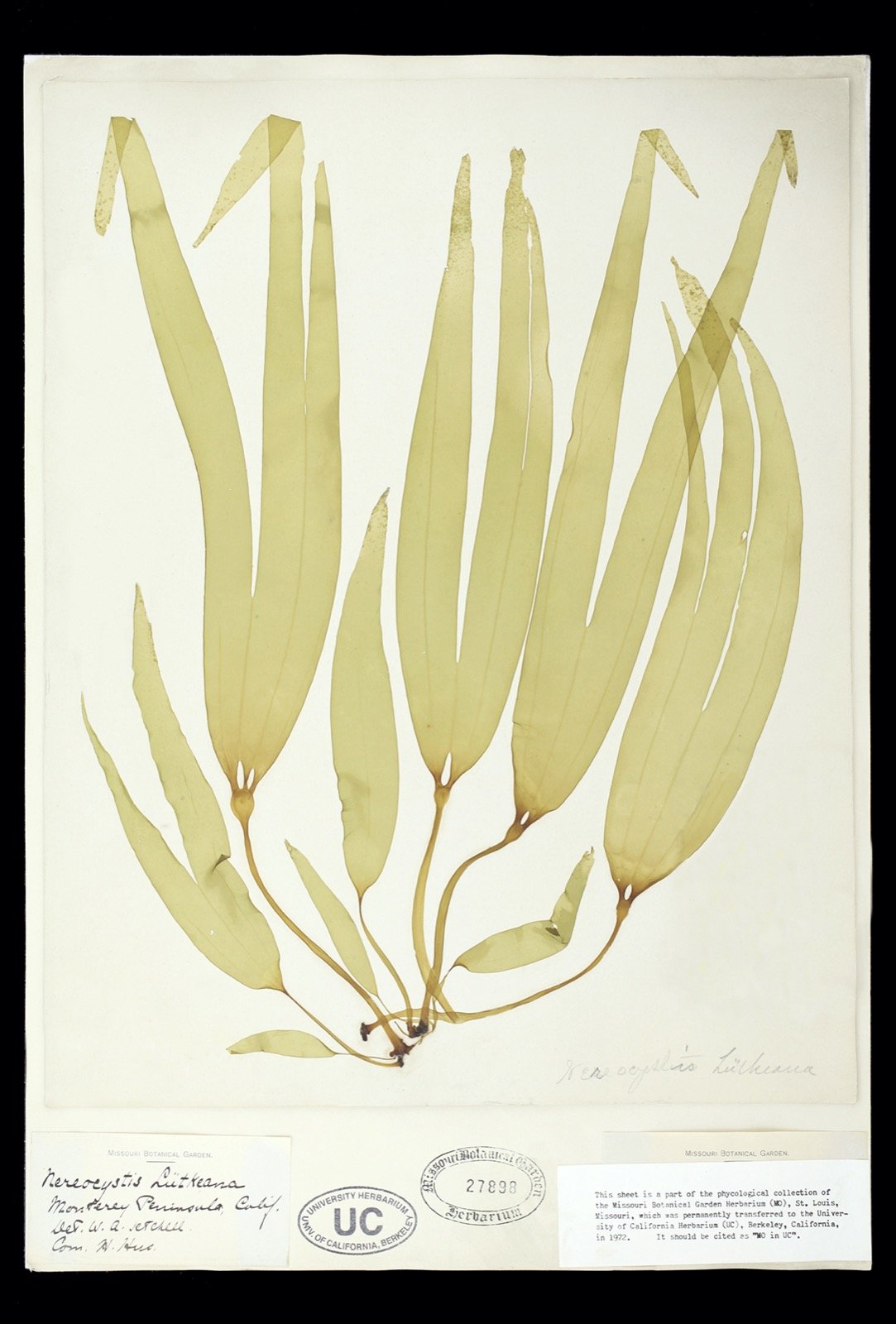
16” x 24” fine art print on Hahnemuhle rag paper with 1” white border. Edition of 10. 100% of proceeds go directly to University & Jepson Herbarium at UC Berkeley.
Nereocystis luetkeana, nine very young sporophytes. University Herbarium, University of California, Berkeley, no. 1983510. From the Monterey Peninsula, no collection date, determined by W.A. Setchell

15” x 19.50” or 29” x 39” fine art print on Hahnemuhle rag paper with 1.5” white border. Edition of 15 or 10.
Postelsia palmaeformis, or sea palm, on a foldout plate from Ruprecht (1852 plate VI), recoloured. Collection of Michael J. Wynne.

15” x 32” or 28” x 60” fine art print on Hahnemuhle rag paper with blue border. Edition of 15 or 10.
Stephanocystis osmundacea or bladder chain wrack. This is a scan of Stephanocystis is combined with the foldout plate from Ruprecht’s 1852 folio (recoloured) describing five iconic kelps and one seagrass from California. In the back of this small publication were five extraordinary lithographs, including what was then called Cystoseira osmundacea, that unfolded to reveal a depiction of the entire specimen, some nine panels long-reaching 48 inches (1.2 metres) or so.

27” x 16” fine art print on Hahnemuhle rag paper. Edition of 15.
Ulva spp. with Ulva fenestrata. A contemporary scan incorporating an illustration by Alexander Postels from Illustrationes algarum (1840). Ulva fenstrata is now Ulva lactuca or sea lettuce. Alexander Postels was a German-born geologist brought on to the Russian exploratory expedition to Alaska in 1829, captained by Frederick Luetke. Postels demonstrated a genius for sketching and an affinity for the enormous and extraordinary seaweeds found along the Alaskan coast. In 1840, in partnership with the botanist Franz Joseph Ruprecht, Postels created one of the most extraordinary folios of marine algae of all time, Illustrationes algarum. Ruprecht’s descriptions are accompanied by Postels’s dynamic, oversized lithographs of each species rendered in full colour.


7” x 12” or 16” x 32” fine art print on Hahnemuhle rag paper. Edition of 15 or 10.
Two juvenile Nereocystis luetkeana with merged holdfast. These two baby bull kelp were collected in springtime from the shore of Fort Funston, the beach at the south end of San Francisco where I walk often. They were brought back to my studio, and scanned while still fresh. Spring is when one often finds baby Nereocystis on the shores, at the water’s edge, their tiny delicate bladder and blades golden in the sunshine. They are a sign that this annual species is starting its cycle afresh. The sporophyte stage of growth begins in later winter/early spring and in a matter of months, by June or July, a mature bull kelp’s stipe and bladder have reached 60 feet (18 metres) or so to the surface when the stipe will stop growing and growth will continue from the base of the blades where they emerge from the bladder. By late summer dark brown sori, or spore patches, will develop on the blades. They will fall away in late summer, each cluster of millions of spores floating to the rocky bottom to disperse and germinate into female and male gametophytes that will produce egg and sperm. This mysterious sexual phase of the giant bull kelp is microscopic and fertilization happens beneath the waves in the roughest winter weather.


26” x 33” fine art print on Hahnemuhle rag paper. Edition of 10.
Postelsia palmaeformis or sea palm. Postelsia palmaeformis is the coolest kelp there is. It seems different from other kelps and seaweeds—kookier, more Dr. Seuss-worthy. Called sea palm because it looks like a diminutive palm tree, it is found nowhere else on earth but the wave-crashed rocks off the coast of northern California, Oregon, Washington, and British Columbia, from the headlands of San Luis Obispo to Vancouver Island. Unlike its kelp compatriots, it does not venture north to Alaska. Usually Postelsia is viewed from afar, growing on barren fragments of the continent that have broken off and sit exposed to the wide Pacific, patiently being pounded into the sands of time.


13” x 18” or 27” x 40” fine art print on Hahnemuhle rag paper. edition of 15 or 10
Erythrophyllum delessaroides with Twiss. The rosy red Erythrophyllum, a treasure to find in the intertidal zone of the Pacific coast is layered onto the published master’s thesis of Wilfred Twiss. UC Berkeley was a pioneer in the number of women scientists that came through their undergraduate and graduate programs, and this publication was found in the papers of Robert F. Scagel upon his retirement from UBC. Many pioneering women scientists have been integral to furthering our knowledge of the seaweeds and of our oceans and they are highlighted throughout the chapters of The Curious World of Seaweed.

10” x 18.75,” 18” x 32.5,” or 30” x 56” fine art print on Hahnemuhle rag paper. Edition of 15, 10 or 10.
Homage to the bull kelp of the Sonoma and Mendocino Coast: scan incorporating illustration of Nereocystis luetkeana by Postels from Illustrationes algarum. The ghost-like image of the Nereocystis refers to the die off of bull kelp on the north coast of California during the years 2016-2020. 2021 has provided a year of great upwelling and cold ocean in California and the ever-opportunistic bull kelp has been making a comeback, despite the explosion of herbivorous purple urchins, proving its resilience and ability to surprise us with its ingenuity. The cyclical nature of bull kelp abundance has been common knowledge to native and commercial harvesters and fishermen for centuries.

10” x 18.75” or 25” x 48” fine art print on Hahnemuhle rag paper. Edition of 15 or 10.
Neoagarum fimbriatum, recoloured, on a Gmelin plate XXXII from Historia Fucorum (1768). These depictions by Gmelin were made from specimens collected by George Stellar in the 1740s either from Bering Island or the Kamchatka Peninsula. Agarum is one of the few kelps that evolved down both coasts of North America, being common in the Gulf of Maine as well as the Gulf of Alaska.

8.75 x 18.75” or 27” x 58” fine art print on Hahnemuhle rag paper. Edition of 15 or 10.
Egregia menziesii, or feather boa kelp, combined with a Ruprecht lithograph of Egregia from his 1852 publication. This lithograph is comprised of nine panels that fold out to an almost life-size depiction of this splendid organism.

20” x 20” or 32” x 32” fine art print on Hahnemuhle rag paper. Edition of 15 or 10.
Fucus distichus, or rockweed, with illustration of Fucus vesiculosus by Alexander Postels from Illustrationes algarum (1840). These are both considered rockweed, one from the west coast (F. distichus) the other from the east coast (F. vesiculosus). The fucoids are a suite of brown algae thought of as rockweed, that often dominate the high intertidal zone.

39” x 31” fine art print on Hahnemuhle rag paper. Edition of 10.
Egregia menziessii, or feather boa kelp. This jazzy specimen was picked up from Fort Funston and gotten onto my scanner while it was still fresh from the ocean. Feather boa kelp is one that cannot wait to be scanned. It loses its fabulousness quickly when away from the ocean.

80” x 64” mural.
Ocean’s Edge I. This is a composite of scans of wet specimens all made in my studio from 2016–2019, but compiled into this large-scale mural as I was archiving my image files at the beginning of the COVID-19 lockdown. I wanted to convey the visual and morphological richness of the intertidal zone, the remarkably biodiverse world of the seaweeds that is just there at the ocean’s edge if we take care to look closely and notice what for so long was overlooked or disregarded.

80” x 64” mural, 70” x 52” or 48” x48”
Ocean’s Edge II. This is a composite of scans of wet specimens all made in my studio from 2016–2019, but compiled into this large-scale mural as I was archiving my image files at the beginning of the COVID-19 lockdown. I wanted to convey the visual and morphological richness of the intertidal zone, the remarkably biodiverse world of the seaweeds that is just there at the ocean’s edge if we take care to look closely and notice what for so long was overlooked or disregarded.
All prints on fine art rag paper in very small editions.

80” x 64” mural, 70” x 52” or 48” x48”
Ocean’s Edge III. This is a composite of scans of wet specimens all made in my studio from 2016–2019, but compiled into this large-scale mural as I was archiving my image files at the beginning of the COVID-19 lockdown. I wanted to convey the visual and morphological richness of the intertidal zone, the remarkably biodiverse world of the seaweeds that is just there at the oceans edge if we take care to look closely and notice what for so long was overlooked or disregarded.


28” x 21” fine art print on Hahnemuhle rag paper. Edition of 10.
Opuntiella californica. The scan of this wonderful specimen (found as drift at Point Reyes National Seashore in California) is at play with its shadow self, made as a cyanotype print in my own backyard. Cyanotypes, or sunprints, are an historical photographic process whereby a light-sensitive emulsion is coated onto paper and kept in the dark until ready to be exposed. Once exposed to sunlight the emulsion stays fast as a deep Prussian blue, but where the emulsion is shadowed by a specimen or object the emulsion washes away to white. Printing techniques, such as this one, whereby the specimen itself is used to make the image, is known as nature printing and my scanning of seaweed specimens to capture their portraits fits into this lineage.

32” x 40” fine art print on Hahnemuhle rag paper. Edition of 10.
Prionitis sternbergii at play with its shadow self, made as a cyanotype print in my own back yard. The interplay of contemporary scan with historical photographic process creates a dialogue through time, a vector from past to present that continues into an unknown future, given the rapidly changing oceans.

20” x 36” fine art print on Hahnemuhle rag paper. Edition of 15.
40” x 72” fine art print on Hahnemuhle rag paper. Edition of 5.
Erythrophyllum delesserioides, a rosy red seaweed common in the intertidal from Central California to Alaska, with its cyanotype.

54” x 75” fine art print on Hahnemuhle rag paper. Edition of 5.
Egregia menziesii on its cyanoptype shadow. I have inverted the scan of this spectacular specimen of feather boa kelp, found at McKerricher State Park, Fort Bragg, Mendocino, CA, to speak in dialogue with its cyanotype counterpart.

21”x16” or 42”x32” or 65”x48” fine art print on Hahnemuhle rag paper. Edition of 15, 10 or 5.
Farlowia mollis at play with its shadow self, made as a cyanotype diptych print in my own back yard. I began making cyanotypes of my marine algae specimens as an homage to Anna Atkins who I started researching back in 2009 for my book Beach: A Book of Treasure. She was a hero to me as a polymath, a Victorian woman schooled in the sciences of the day, including chemistry, to master the nascent cyanotype techniques. She was a superb draughtsman, a naturalist and she created the first photographically reproduced book titled: British Algae: Cyanotype Impressions in 1843, to illustrate the recent publication on British algae by William Henry Harvey which to Atkins’ frustration had no illustrations at first release.

12” x 45” (can hang either vertically or horizontally) fine art print on Hahnemuhle rag paper. Edition of 15
20” x 77” (can hang either vertically or horizontally) fine art print on Hahnemuhle rag paper. Edition of 10
35” x 135” (can hang either vertically or horizontally) fine art print on Hahnemuhle rag paper. Edition of 5.
Chasing Kelp: Nereocystris leutkeana. This combination of a scan with its cyanotype trio can hang either horizontally or vertically. This has become the iconic image of my ongoing research into the remarkable world of bull kelp; of my continued exploration into its mystery and magic.