
The Curious World of Seaweed
Fine art prints from the exhibit at Beaty Biodiversity Museum, Vancouver CA
Spot for description. Lorem ipsum dolor sit amet, consectetur adipiscing elit, sed do eiusmod tempor incididunt ut labore et dolore magna aliqua. Ut enim ad minim veniam, quis nostrud exercitation ullamco laboris nisi ut aliquip ex ea commodo consequat.
Pyropia/nori

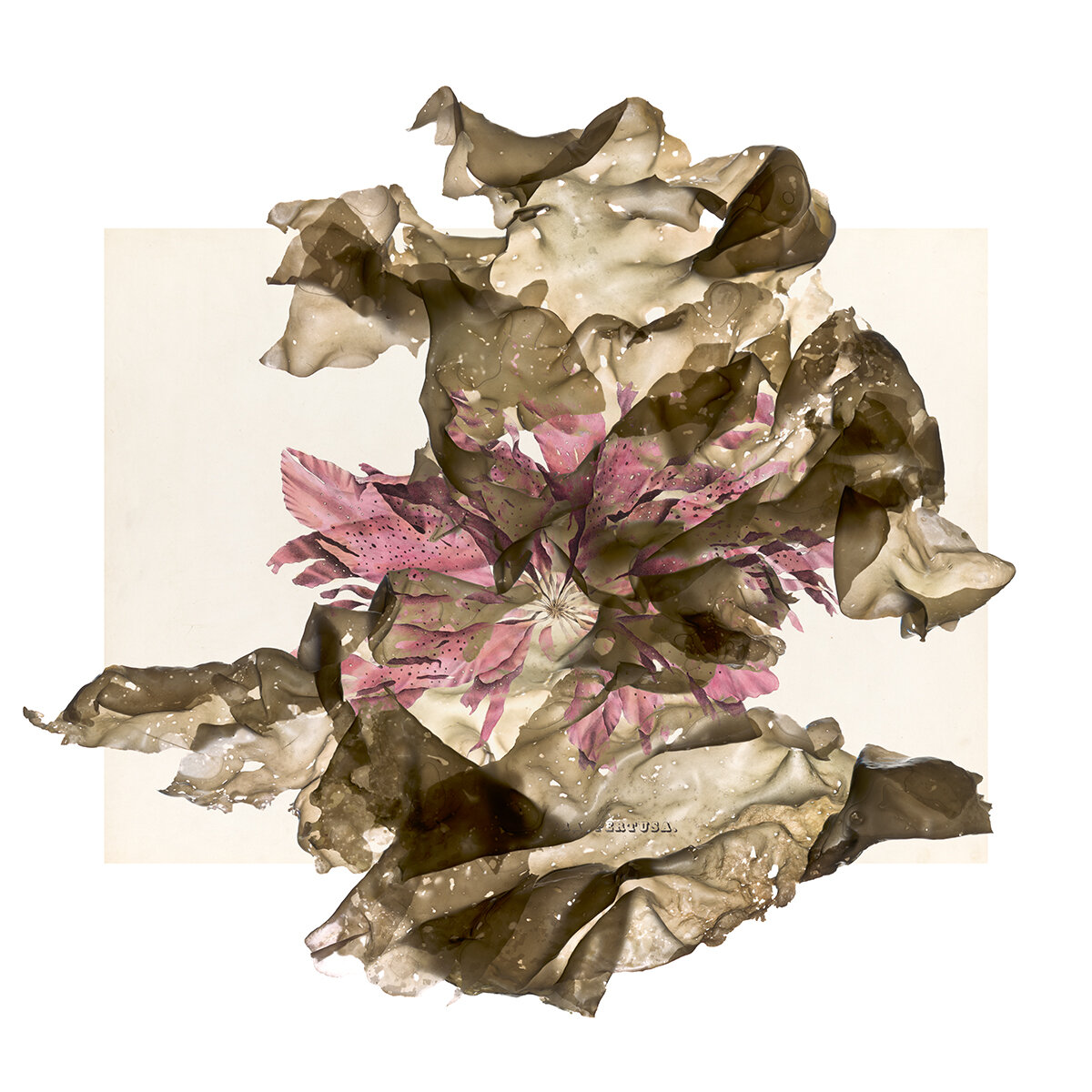
20” x 20” or 32” x 32” fine art print on Hahnemuhle rag paper. Edition of 15 or 10.
Pyropia with Porphyra pertusa. Scan incorporating illustration by Alexander Postels from Illustrationes algarum (1840).
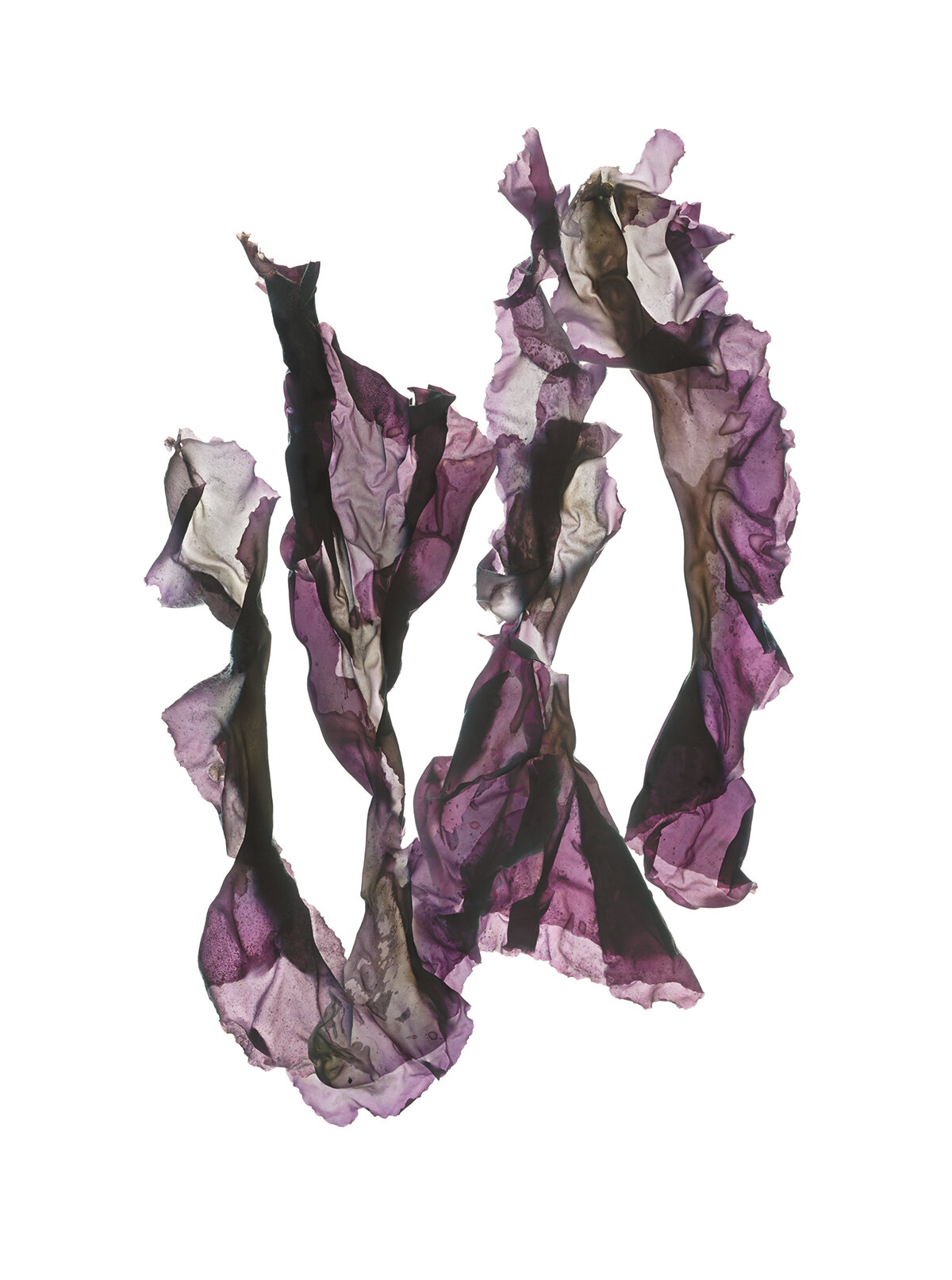
16” x 21” fine art print on Hahnemuhle rag paper. Edition of 15.
Scraps of Pyropia spp. Pyropia can be dusky green, almost black or vibrantly purple, like these scraps of dancing nori. No matter what outward colour, they are in the red category of seaweed, and their complex life cycle was teased out by British phycologist, Kathleen Drew-Baker. Drew-Baker had noticed with intrigue the fall bloom of Porphyra, locally known as laver. She focused her attention on this alga and what she initially supposed was a different species, the filamentous algae Conchocelis that grew as splotches of red or purple in old oyster shells. Her great discovery was that these two were not different species but different life stages of the same one. The familiar Porphyra in the local (UK) laverbread and what the Japanese press into sheets of nori were but one stage of an alternating generational cycle. Drew-Baker wrote up her observations and a simple description of the two stages of Porphyra’s life history.


16” x 21” fine art print on Hahnemuhle rag paper with 1” white border. Edition of 10. 100% of proceeds go directly to University & Jepson Herbarium at UC Berkeley.
Pyropia with Pyropia (formerly Porphyra). Two specimens of Pyropia, the Pacific version of Porphyra or nori are combined, one collected by Kathy Ann Miller, Bodega Head, California, 2008, the other (Porphyra growing on Nereocystis) collected in Kodiak, Alaska in 1899, both from the collections at the University Herbarium, University of California, Berkeley, nos. 95674 & 1965038.


34” x 26” fine art print on Hahnemuhle rag paper. Edition of 10.
Pyropia perforata, or nori. Note the fertile edges. Pyropia is only two cells thick, every cell on the translucent blades is able to photosynthesize and every cell can gather nutrients directly from the ocean waters around it. Nori dries out to a crisp at low tide when the sun and wind are desiccating forces, but rehydrates every six hours as the tide comes in.
Postelsia/Egregia

15” x 19.50” or 29” x 39” fine art print on Hahnemuhle rag paper with 1.5” white border. Edition of 15 or 10.
Postelsia palmaeformis, or sea palm, on a foldout plate from Ruprecht (1852 plate VI), recoloured. Collection of Michael J. Wynne.


26” x 33” fine art print on Hahnemuhle rag paper. Edition of 10.
Postelsia palmaeformis or sea palm. Postelsia palmaeformis is the coolest kelp there is. It seems different from other kelps and seaweeds—kookier, more Dr. Seuss-worthy. Called sea palm because it looks like a diminutive palm tree, it is found nowhere else on earth but the wave-crashed rocks off the coast of northern California, Oregon, Washington, and British Columbia, from the headlands of San Luis Obispo to Vancouver Island. Unlike its kelp compatriots, it does not venture north to Alaska. Usually Postelsia is viewed from afar, growing on barren fragments of the continent that have broken off and sit exposed to the wide Pacific, patiently being pounded into the sands of time.

39” x 31” fine art print on Hahnemuhle rag paper. Edition of 10.
Egregia menziessii, or feather boa kelp. This jazzy specimen was picked up from Fort Funston and gotten onto my scanner while it was still fresh from the ocean. Feather boa kelp is one that cannot wait to be scanned. It loses its fabulousness quickly when away from the ocean.

8.75 x 18.75” or 27” x 58” fine art print on Hahnemuhle rag paper. Edition of 15 or 10.
Egregia menziesii, or feather boa kelp, combined with a Ruprecht lithograph of Egregia from his 1852 publication. This lithograph is comprised of nine panels that fold out to an almost life-size depiction of this splendid organism.